Solar panels in Eagle Mountain: what they cost and what they make
A typical Eagle Mountain home needs 15 solar panels. They would make about 9,932 kWh a year and cost $16k to $24k before incentives. At today's electricity prices they pay for themselves in about 14.2 yrs.
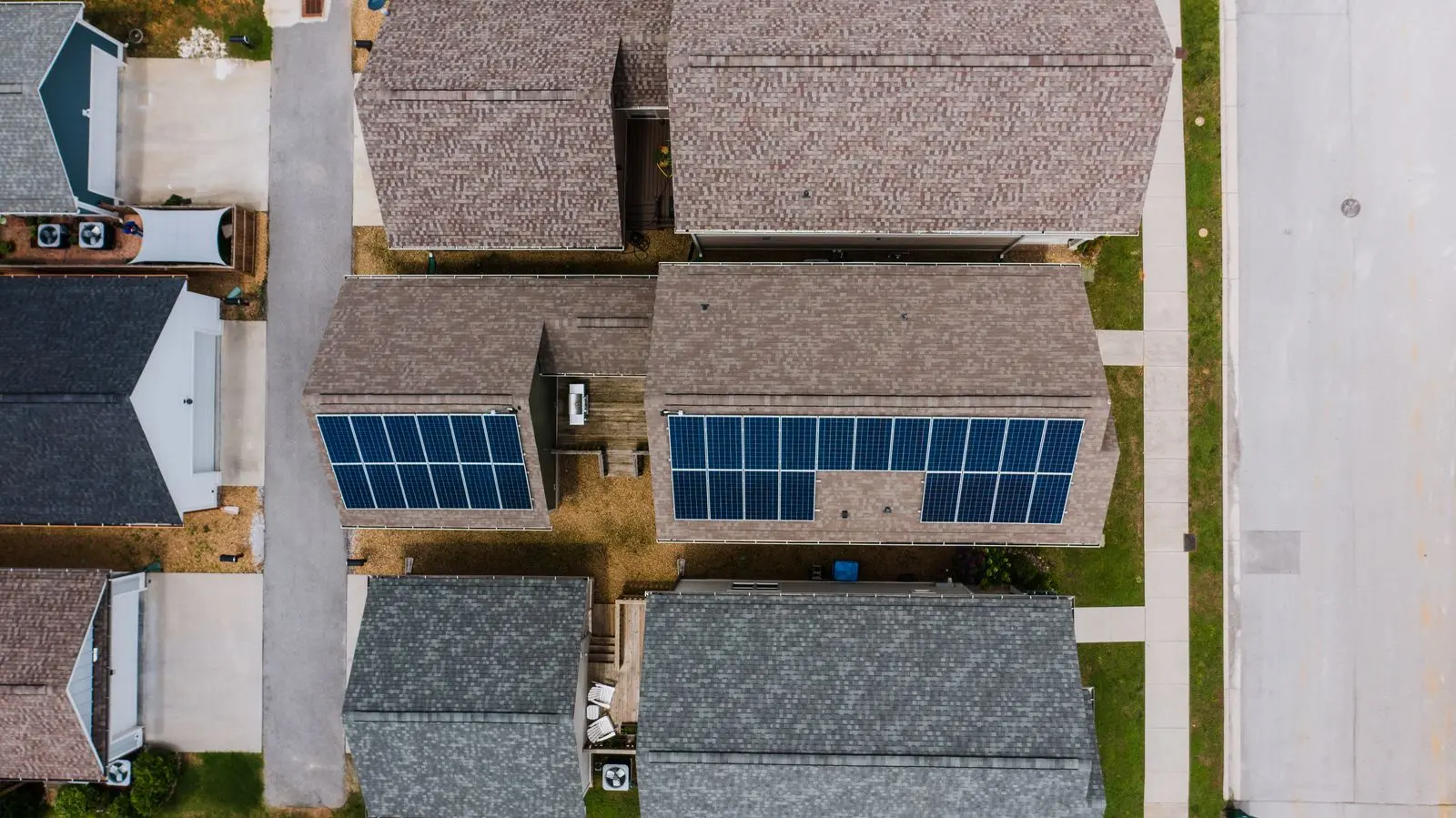
See panels on your own Eagle Mountain roof
Type your address. You get your roof from above, the panels that fit, a month-by-month forecast and a battery test. No phone number.
What solar costs in Eagle Mountain
At $3.00 a watt, the median price cash buyers pay nationally, a 6.3 kW system costs about $18,900. Quotes in Eagle Mountain will usually fall between $15,750 and $23,625. Complex roofs, main-panel upgrades and financing push prices up.
The 30% federal tax credit no longer applies to systems homeowners buy. This estimate includes no state or utility incentives; check with your utility before you buy.
The number that decides whether solar pays in Eagle Mountain is what your utility pays for the power you send back. Under full payback is about 14.2 yrs. Under net billing it is about 23.3 yrs, because only the ~41% of solar a typical home uses as it is made saves the full retail price.
Cash purchase, prices rising 2.5% a year, panels losing 0.5% a year, $25/kW a year for upkeep. No federal credit for homeowner-owned systems.
Every way to pay for a 6.3 kW system in Eagle Mountain
Change any number →| Way to pay | Day one | Monthly payment | Monthly net, year 1 | Ahead after 25 years |
|---|---|---|---|---|
| Pay cash Full price on install day | $18,900 | $0 | +$96 | $19k |
| Credit-union loan 8% APR, 20 years, no dealer fee | $0 | $158 | −$62 | −$100 |
| “1.99%” solar loan 1.99% APR, 25 years, 25% dealer fee | $0 | $100 | −$4 | $7,900 |
| Lease $95/mo, +2.9%/yr | $0 | $95 | +$14 | $800 |
| Power purchase (PPA) 11.2¢/kWh, +2.9%/yr | $0 | $93 | +$16 | $4,400 |
Under net metering, at 13.2¢/kWh rising 2.5% a year. The “1.99%” loan’s $4,725 dealer fee is included in its payments. Lease and PPA prices are typical offers, not quotes.
How much sunshine Eagle Mountain gets
kWh per kW, 25° southJun is the best month for solar in Eagle Mountain, and Dec the weakest: a Dec day makes 46% of a Jun day. A 6 kW system would make about 464 kWh in Dec and 1,004 kWh in Jun.
On June 21 the sun rises at 5:58 am and sets at 9:01 pm, 15 hours 3 minutes of daylight. On December 21 it is up from 7:47 am to 5:05 pm, just 9 hours 17 minutes.
Peak sun hours in Eagle Mountain, month by month
| Month | Flat ground | Panels at 36° | kWh per kW |
|---|---|---|---|
| Jan | 2.2 | 3.9 | 89 |
| Feb | 3.2 | 4.7 | 100 |
| Mar | 4.5 | 5.7 | 137 |
| Apr | 5.7 | 6.2 | 148 |
| May | 6.7 | 6.4 | 160 |
| Jun | 7.8 | 7.0 | 167 |
| Jul | 7.5 | 6.8 | 164 |
| Aug | 6.6 | 6.8 | 159 |
| Sep | 5.5 | 6.7 | 148 |
| Oct | 3.9 | 5.8 | 131 |
| Nov | 2.5 | 4.4 | 96 |
| Dec | 1.9 | 3.4 | 77 |
| Year | 4.8 | 5.6 | 1,576 |
A peak sun hour is one hour of sunlight at 1,000 W per m². Why sites disagree.
The best angle and direction for panels in Eagle Mountain
| Roof faces (6/12 pitch) | Output vs south | kWh per kW |
|---|---|---|
| South | 100% | 1,576 |
| Southeast | 95% | 1,497 |
| Southwest | 95% | 1,497 |
| East | 83% | 1,308 |
| West | 82% | 1,292 |
| North | 60% | 946 |
Face panels south and tilt them 36° for the most energy over a year. East and west roofs keep about 83% of that. A north-facing roof keeps 60%, which is rarely worth the money. Try other angles.
Where the sun goes over Eagle Mountain
The noon sun is lower in winter, which is why the best winter tilt (64°) is steeper than the best summer tilt (11°).
Eagle Mountain's homes
Eagle Mountain has 12,744 households. 84.7% own their home, and 10,460 of those owners live in single-family houses, the kind of home that usually gets rooftop solar.
The median home here was built in 2012. Most roofs this young have years of life left, which makes them good candidates for solar.
14.6% of homes heat with electricity and 83.9% with gas. If you switch to a heat pump or an electric car, plan for more panels or leave room on the roof.
Source: U.S. Census Bureau, American Community Survey 2020–2024 5-year estimates.
If the power goes out in Eagle Mountain
Solar panels alone shut off in a blackout. Add a battery and they keep going. One Tesla Powerwall 3 (13.5 kWh) running a fridge, freezer, furnace fan, lights, Wi-Fi, TV and microwave (6.9 kWh a day):
Change the appliances, the battery and the weather in the battery calculator.
Questions people ask about solar in Eagle Mountain
How much do solar panels cost in Eagle Mountain?
A 6.3 kW system — enough for the average Utah home — costs about $15,750 to $23,625 before incentives, based on $2.50–$3.75 per watt. The 30% federal credit no longer applies to systems homeowners buy.
How many solar panels does a house in Eagle Mountain need?
About 15 panels of 420 watts for a home using 774 kWh a month, the Utah average. Each kilowatt of panels here makes about 1,576 kWh a year on a south-facing roof.
Is solar worth it in Eagle Mountain?
Over 25 years, solar power here costs about 9.8¢ per kWh, against 13.2¢ from the grid today. Payback is about 14.2 yrs if your utility credits exported power at the full retail rate, and 23.3 yrs if it pays about 30% of retail.
How many peak sun hours does Eagle Mountain get?
5.6 a day on panels tilted to 36°, and 4.8 on flat ground. The best month is Jun; the weakest is Dec.
What is the best angle for solar panels in Eagle Mountain?
36° for the most energy over a year, facing south. 64° is best in winter and 11° in summer. On a normal pitched roof, anything within 15° of 36° gives you about 95% of the maximum.
How long would a home battery last in a Eagle Mountain power outage?
A Tesla Powerwall 3 running a fridge, freezer, furnace fan, lights, Wi-Fi, TV and microwave (6.9 kWh a day) lasts about 43 hours with no sun. With 7 kW of solar to recharge it, it gets through a three-day outage even in overcast January.
Solar near Eagle Mountain
| City | Miles | kWh per kW | Sun hours |
|---|---|---|---|
| Saratoga Springs, UT | 5 | 1,600 | 5.6 |
| Lehi, UT | 10 | 1,594 | 5.6 |
| Herriman, UT | 12 | 1,590 | 5.6 |
| Draper, UT | 15 | 1,589 | 5.6 |
| Orem, UT | 16 | 1,602 | 5.6 |
Eagle Mountain shares a weather-data neighbourhood with Provo; their sunshine numbers differ by less than our data can resolve. Housing, prices and outage figures are specific to Eagle Mountain.
Cities with the same sunshine as Eagle Mountain
These far-away cities get almost exactly as much solar energy per panel.
- Chico, CA 1,615 kWh per kW
- Abilene, TX 1,616 kWh per kW
- San Angelo, TX 1,626 kWh per kW
Snow: NASA records about 19 cm of snow on the ground here in an average January. Covered panels make little until it slides off, and these figures (like PVWatts') don't subtract that.
Sources: NASA POWER 2001–2020 monthly climatology (grid cell 46 km from Eagle Mountain's Census point), our PV model (within 1.6% of NLR PVWatts® on average), U.S. EIA prices and use, U.S. Census 2025 population estimates and ACS 2020–2024. Estimates for an average home, not a site survey. How we calculate.